

HARRIET PARRY
Based in London, Harriet Parry is a floral artist whose vibrant work celebrates colour, playfulness, and the unexpected. Using flowers as her medium, she crafts imaginative compositions where creativity, humour, and joy come into full bloom—offering a fresh visual language that invites viewers to see the world anew. At the heart of her practice is Flower Interpretations, an ongoing series that reimagines historical and contemporary artworks as witty and expressive floral arrangements. Presented as limited edition prints, these pieces form a dialogue between nature and art, inviting us to pause and look again.
With a background in Fine Art and a deep connection to the natural world, Parry works across photography, sculpture, and site-specific installation. Her work has been featured by leading institutions including Tate, the Royal Academy of Arts, and Fondation Louis Vuitton; in publications such as Vogue, The World of Interiors, and The Guardian; and in collaborations with brands including Hermès, Lacoste, and Burberry. In an increasingly fast-paced world, Harriet Parry offers moments of wonder—encouraging us to experience the magic of nature and the beauty of seeing things differently.

Harriet Parry’s floral interpretation of Dancing Through The Night by Guglielmo Castelli offers a poetic response to the haunting elegance of the figure at its heart. Castelli’s portrait, with its ethereal palette and introspective mood, evokes a world of quiet emotion and layered meaning.
Through a sensitive selection of blooms and textures, Parry draws out the subtle tensions of the work, the delicacy of the figure, the softness of light, and the interplay between concealment and revelation. The floral composition mirrors the painting’s muted tones and enigmatic atmosphere, transforming the stillness of the canvas into a living, breathing form.
This interpretation invites viewers to engage with Castelli’s portrait in an entirely new way, through scent, texture, and the fleeting beauty of nature, in dialogue with the timeless power of the painted figure.
Limited Edition Signed & Numbered Giclee Print, on Hahnemühle Photo Rag.
A2 Edition of 50.

In her floral interpretation of Letter G by Erté, Harriet Parry translates the elegance and stylised glamour of the Art Deco master into a living composition of blooms. Erté’s original, a celebration of form, fashion, and typographic artistry, is reimagined through Parry’s meticulous eye for colour, line, and texture.
With carefully chosen flowers and foliage, Parry evokes the flowing curves, intricate detail, and sophisticated drama that define Erté’s work. The result is both playful and refined, a floral homage that captures the spirit of an era while adding the ephemeral beauty of nature.
Through this transformation, Parry invites us to see the enduring allure of Erté’s design through a new, sensory lens, where petals replace paint, and fragrance adds a new dimension to visual elegance.
Limited Edition Signed & Numbered Giclee Print, on Hahnemühle Photo Rag.
A2 Edition of 50.

Harriet Parry’s floral interpretation of Félix-Marie Hippolyte Lucas’s A Beauty in Pink captures the elegance and allure of the original portrait through an evocative arrangement of blooms. Lucas’s painting, with its delicate rendering of feminine grace, soft textures, and romantic palette, finds new life here in the language of flowers.
Parry’s choice of blossoms — layered, luminous, and tenderly hued — mirrors the subtle charm and quiet confidence of the figure, translating painted silk and skin into petals and scent. The arrangement invites the viewer to consider the timeless dialogue between art, beauty, and nature, and the ways in which each can reflect and elevate the other.
In this transformation, Parry offers not merely a tribute, but a living extension of Lucas’s vision — one that breathes, fades, and lingers, much like beauty itself.
Limited Edition Signed & Numbered Giclee Print, on Hahnemühle Photo Rag.
A2 Edition of 50.
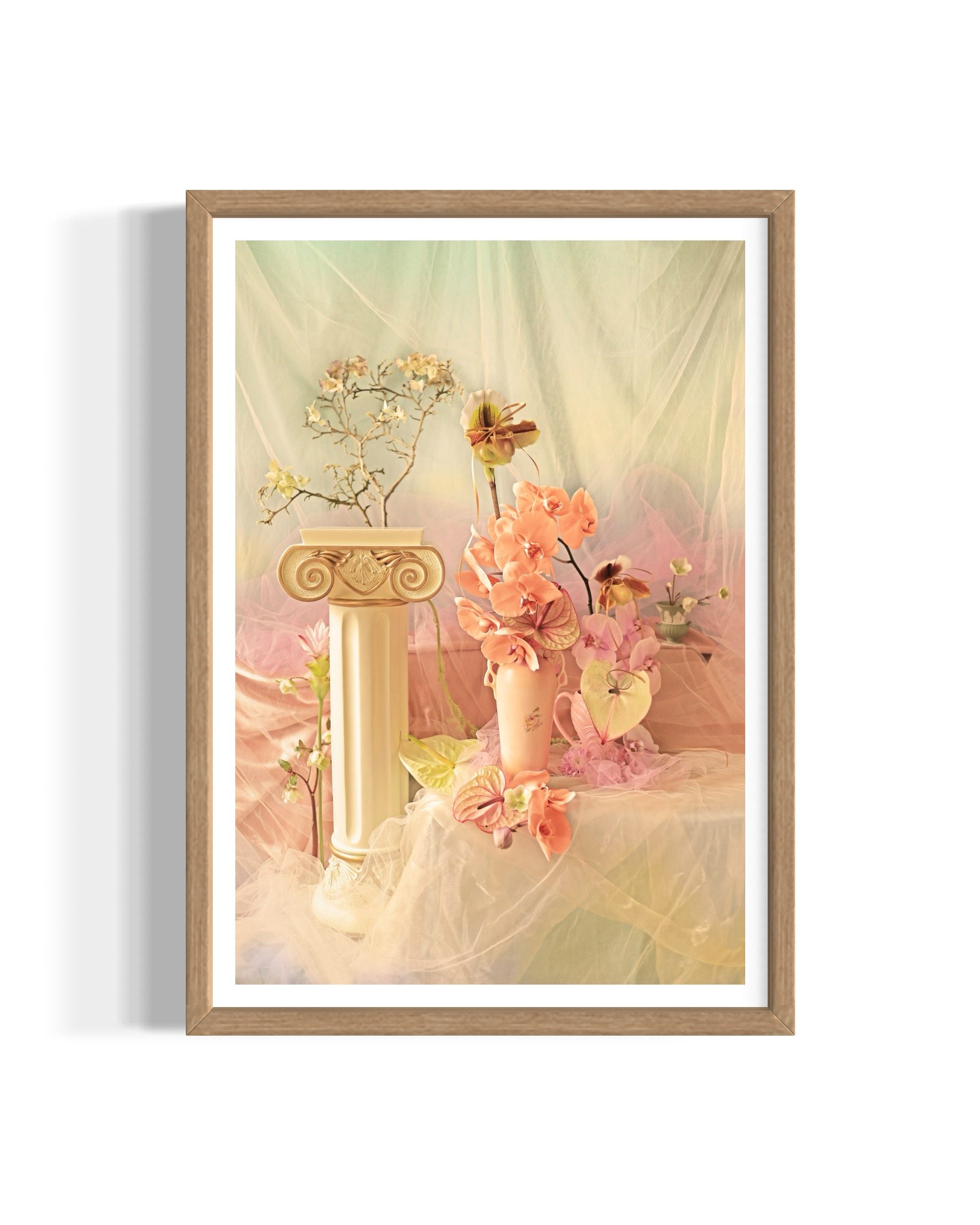
In this exquisite interpretation, floral artist Harriet Parry reimagines Evensong by Charles Frederick Lowcock — a work steeped in atmosphere and quiet reverence. Lowcock’s painting, with its gentle play of light and shadow at the close of day, evokes a moment of stillness, a hush that descends as nature prepares for night.
Parry translates this mood into a delicate arrangement of flora and fauna, where blooms and natural elements echo the softness and depth of Lowcock’s palette. Each botanical choice reflects the painter’s nuanced tonality — petals as brushstrokes, leaves as whispered notes of dusk. The ephemeral qualities of the materials mirror the fleeting beauty of twilight itself, inviting the viewer to pause and experience the poetry of the moment through scent, texture, and form.
Together, painting and floral interpretation become a meditation on transience, harmony, and the quiet grace of nature’s daily rituals.
Limited Edition Signed & Numbered Giclee Print, on Hahnemühle Photo Rag.
A2 Edition of 50.
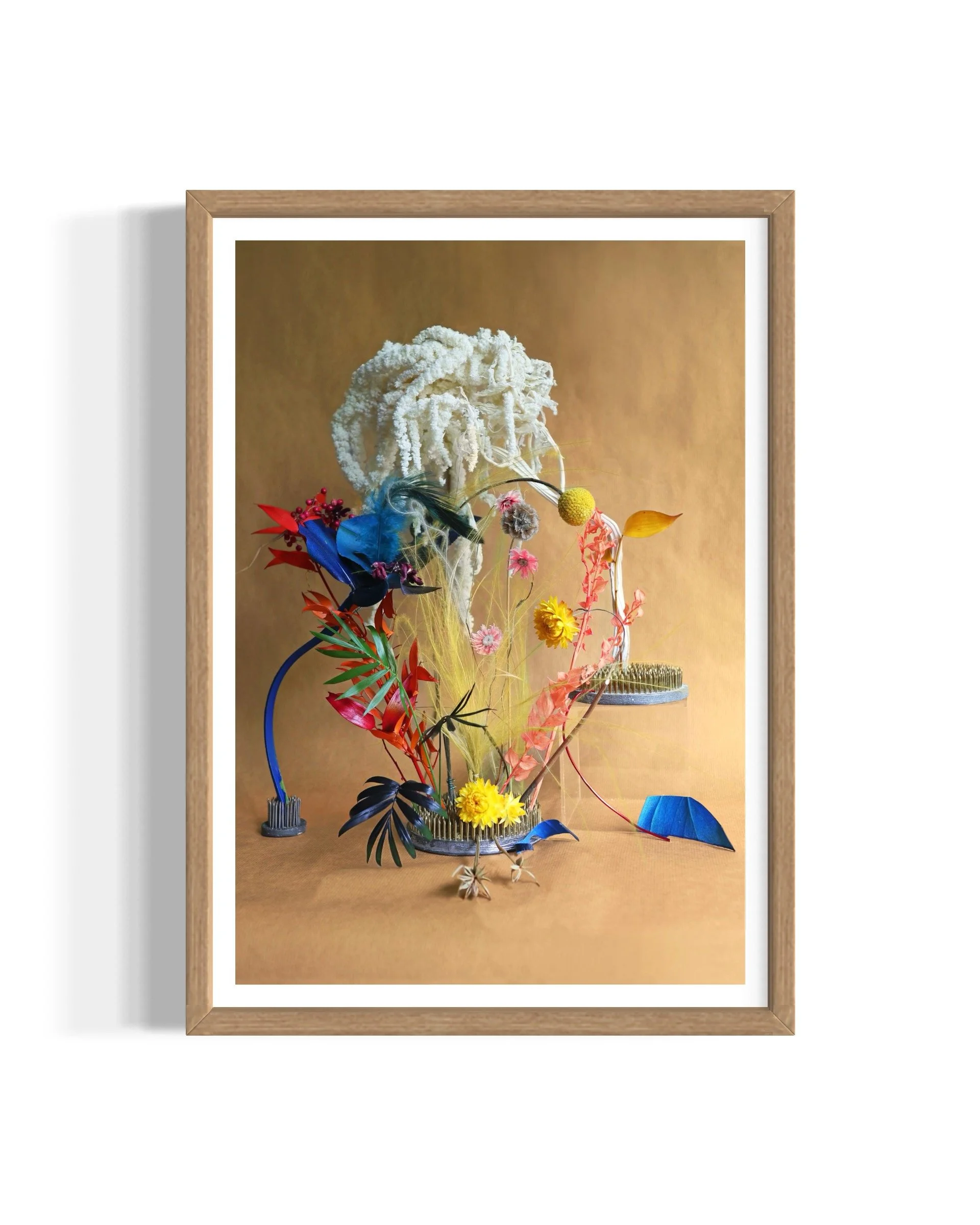
Harriet Parry’s floral interpretation of Loribelle Spirovski’s HOMME-99 translates the bold, sculptural, yet incomplete quality of the original work into an equally striking composition in flowers. Spirovski’s piece, with its exploration of identity, form, and the tension between softness and structure, finds an echo here in Parry’s masterful use of botanical materials.
Through an intentional selection of blooms and foliage, at times sharp, at times supple — Parry brings dimension and life to the simple yet colourful aesthetic of HOMME-99, evoking its sense of modern masculinity with a floral language. The arrangement plays with contrast, shadow, and silhouette, reflecting the original’s graphic power while introducing ephemeral beauty and natural textures.
This is not merely a translation from one medium to another, but a dialogue between art forms, a contemporary meditation on gender, strength, and vulnerability, expressed through the fleeting artistry of flowers.
Limited Edition Signed & Numbered Giclee Print, on Hahnemühle Photo Rag.
A2 Edition of 50.

In this floral work, Harriet Parry responds to Hand with Roses and Lover’s Eye, a painting by Fatima Ronquillo, whose art is known for its poetic blend of Old Master techniques and contemporary storytelling. The original painting presents a single hand, delicately offering roses, adorned with a miniature “lover’s eye” — a motif rich in history, secrecy, and devotion.
Parry’s interpretation brings this quiet, intimate gesture into three dimensions through a lyrical arrangement of blooms. The choice of roses nods to traditional symbols of love and beauty, while subtle variations in texture and tone mirror the layers of emotion in Ronquillo’s work. The arrangement captures not only the visual elegance but also the underlying narrative — of longing, remembrance, and the fragility of human connection.
Through her sensitive and inventive approach, Parry invites us to experience the painting afresh — transforming brushstrokes into petals, and paint into living, breathing form.
Limited Edition Signed & Numbered Giclee Print, on Hahnemühle Photo Rag.
A2 Edition of 50.

This floral piece from Harriet Parry reimagines an iconic 1948 French Vogue cover, an elegant illustration where nature itself becomes fashion. The original image, designed at a moment of post-war renewal, features a bouquet of wheat, wildflowers, and grasses cleverly shaped into the form of a human face, complete with a scarf knotted at the neck.
In this interpretation, fresh botanicals breathe new life into that vision — a celebration of the artistry and with that characterised mid-century French fashion illustration. The composition honours the original’s delicate play between figure and flora, and between natural abundance and cultivated style. Wheat stalks and meadow blooms evoke the rhythms of the countryside, while the scarf — recreated through silk, adds a note of urban chic.
Both nostalgic and contemporary, the arrangement reflects the timeless allure of fashion’s dialogue with nature — a conversation as vibrant today as it was in 1948.
Limited Edition Signed & Numbered Giclee Print, on Hahnemühle Photo Rag.
A2 Edition of 50.

In Jacques-Joseph Tissot’s portrait of The Princess de Broglie, elegance is rendered with near-cinematic precision. Tissot, known for his meticulous attention to fabric, gesture, and social nuance, presents the Princess seated with poised restraint. Her silken gown and ornate surroundings speak to the codes of aristocratic femininity, while her composed gaze suggests both privilege and isolation—a woman shaped by society, yet slightly removed from it.
The floral interpretation translates these themes into a language of petals and structure. The arrangement mirrors the portrait’s layered opulence with carefully chosen blooms—evoking the Princess’s delicacy and refinement. But there’s tension beneath the beauty. Spindly branches or slightly overripe blooms might nod to the constraints of image and decorum, suggesting the subtle burden of perfection. Like Tissot’s painting, the floral work invites viewers to look closer—not just at surface beauty, but at the quiet emotional charge held within it.
Limited Edition Signed & Numbered Giclee Print, on Hahnemühle Photo Rag.
A2 Edition of 50.

Otto Dix’s 1926 portrait of Sylvia von Harden captures the essence of the New Woman—aloof, intellectual, and defiantly modern. Her angular pose, cropped hair, monocle, and cigarette all signal a sharp break from convention.
In floral response, Harriet Parry channels this same sense of cool defiance and modernity. Her arrangement emphasises structure over softness, with sculptural blooms and stark contrasts reflecting the sitter’s uncompromising presence. Muted tones nod to Dix’s palette, while unexpected textures evoke von Harden’s layered persona—at once stylish, cerebral, and subversive.
Limited Edition Signed & Numbered Giclee Print, on Hahnemühle Photo Rag.
A2 Edition of 50.

Luis Falero’s Twin Stars (1881) is a celestial fantasy—an exquisite example of 19th-century academic painting that fuses myth, sensuality, and astronomy. Inspired by the poetic mysticism of the heavens, Falero depicts two nude female figures—representing the binary star system—entwined mid-orbit in a dreamlike cosmic embrace. Suspended in a star-dappled sky, their bodies mirror and balance each other, embodying harmony, duality, and gravitational pull.
In response, this floral interpretation draws from both the painting’s ethereal palette and its symbolic undercurrents. The arrangement plays with symmetry and motion, using paired blooms and spiraling tendrils to echo the twin forms in orbit. Pale roses and white orchids suggest celestial purity and luminosity, while trailing vines and darker-toned foliage hint at the gravitational tension binding the stars together.
Colour and form are essential to this interpretation: soft pastels recall the moonlit glow of Falero’s sky, while iridescent and textural elements mimic the painting’s interplay between sensuality and the sublime. There is a deliberate theatricality at play—honouring the romanticism of the original while embracing the surreal, otherworldly atmosphere that Falero so masterfully conjures.
This floral response doesn’t aim to recreate the painting, but to evoke its mood—offering a transient, earthbound constellation of petals that mirrors the eternal cosmic dance above.
Limited Edition Signed & Numbered Giclee Print, on Hahnemühle Photo Rag.
A2 Edition of 50.

Barkley L. Hendricks’ William Corbett is a masterclass in presence. With his signature precision and reverence, Hendricks renders his subject in stark, elegant simplicity—Corbett stands coolly poised, his coat beacon of clarity against a nearly spectral background. The painting hums with restraint and dignity, offering a portrait that is both intimate and iconic.
Harriet Parry responds not with mimicry but with reverence of her own—composing a floral arrangement that speaks to the poise, power, and quiet confidence at the heart of Hendricks’ portrait. Her palette is crisp and considered: whites, creams, and a flash of magenta nod to Corbett’s attire, while sculptural blooms echo the formality and finesse of his stance.Yet Parry also injects a subtle tension: unexpected textures, minimalist lines, and controlled asymmetry add a contemporary rhythm. Like Hendricks, she plays with stillness and style—suggesting that refinement is not the absence of personality, but its perfect containment.
This floral interpretation becomes a kind of echo chamber: Parry’s flowers reflect Hendricks’ commitment to honouring Black presence with gravity and grace, while also asserting their own ephemeral authority. The arrangement holds space—much like the portrait itself—for elegance, individuality, and quiet resistance.
Limited Edition Signed & Numbered Giclee Print, on Hahnemühle Photo Rag.
A2 Edition of 50.

Erik Mark Sandberg’s Youth With Floral Headband presents a glitter-dusted adolescent caught in a moment of uneasy glamour. The figure’s luxuriant body hair and faraway gaze form a tableau that’s part Renaissance, part pop surrealism, and wholly unforgettable. It’s a portrait that buzzes with beauty, discomfort, and digital-age mythology.
Enter Harriet Parry, floral artist extraordinaire, who translates Sandberg’s world not with brushstrokes, but with petals, stems, and scent. Her response isn’t a bouquet—it’s a mood. Taking cues from the painting’s candy-coloured palette and layered textures, Parry crafts a floral composition that feels alive with contradiction: lush but restrained, romantic yet unsettling, artificial and organic all at once.
The floral headband is reimagined as a symbol—of youth’s ornamentation, self-styling, and fleeting bloom. Flowers both echo and exaggerate the tension in Sandberg’s work: their beauty is temporal, their arrangement precise, yet always at the edge of decay. There’s a playful defiance in Parry’s work, mirroring the subject’s quiet, stylised rebellion.
Together, painting and floral interpretation form a kind of duet—a strange and beautiful harmony between artifice and authenticity, identity and transformation. In Parry’s hands, floristry becomes commentary: on image-making, gender performance, and the fragile theatre of youth.
Limited Edition Signed & Numbered Giclee Print, on Hahnemühle Photo Rag.
A2 Edition of 50.

In her floral response to William Blake Richmond’s The Bath of Venus, Harriet Parry translates the classical serenity and sensuality of the original painting into a composition of living blooms. Richmond’s Venus, bathed in soft light and surrounded by a tranquil, mythic atmosphere, becomes a muse not for replication but for transformation. Parry’s arrangement captures the opulence and quiet reverence of the scene through creamy petals, fluid forms, and a restrained yet luminous palette. Echoing the painting’s balance of stillness and vitality, the flowers evoke both the divine and the earthly—an offering to beauty, ritual, and the timeless allure of the natural world.
Limited Edition Signed & Numbered Giclee Print, on Hahnemühle Photo Rag.
A2 Edition of 50.

Unlike her interpretative responses to works of art, Futures marks a bold conceptual departure for Harriet Parry—an entirely original vision that imagines a world built not in relation to the past, but projected into an uncertain, speculative future. Constructed entirely from mushrooms, fungi, and psilocybin fibres, Futures conjures a dystopian yet oddly wondrous landscape where organic matter has overtaken the architectural and the artificial.
It is both a psychedelic dreamscape and a meditation on resilience, regeneration, and the unknowable intelligence of the natural world. Parry’s use of mycelial structures suggests a living network—fragile yet interconnected—hinting at altered states of consciousness, post-human ecologies, and the potential of fungi as both material and metaphor. In this imagined future, decay becomes creation, and the boundaries between self, environment, and perception dissolve into a lush, unsettlingly beautiful terrain. Futures invites us to consider not only what comes next, but how we might feel, sense, and grow within it.
Limited Edition Signed & Numbered Giclee Print, on Hahnemühle Photo Rag.
A2 Edition of 50.

In her floral interpretation of Hester Finch’s Nude on Orange with Purple Ground, Harriet Parry responds not only to the painting’s striking palette but also to its psychological depth. Finch’s nude, rendered in poised yet vulnerable repose, is framed by saturated blocks of orange and violet—colours that radiate both heat and introspection. Parry’s arrangement echoes this chromatic tension through the careful selection of blooms in warm, fiery tones offset by rich purples and deep greens.
The flowers are not simply decorative; they act as a spatial and emotional echo of the figure’s internal world—structured yet soft, exposed yet composed. By translating Finch’s exploration of the female body and its presence in space into living material, Parry engages in a parallel act of composition—one that honours the quiet strength and layered complexity at the heart of Finch’s work.
Limited Edition Signed & Numbered Giclee Print, on Hahnemühle Photo Rag.
A2 Edition of 50.

Harriet Parry’s floral response to John William Waterhouse’s Windflowers delicately reanimates the ethereal world of Pre-Raphaelite romanticism. In Waterhouse’s painting, a young woman pauses in a windswept landscape, her garments and hair stirred by an unseen breeze, as she gathers delicate blooms—perhaps anemones, symbolising both fragility and the fleeting nature of life. There is a quiet tension between stillness and movement, between the earthly and the otherworldly.
Parry’s arrangement honours this moment of suspended reverie. She draws on the same palette of dusky pinks, soft whites, and muted greens to evoke the transient beauty of the wildflowers clutched in the girl’s hands. Wisps of foliage trail like strands of windblown hair, while gently arching stems suggest the motion of the breeze itself. As in Waterhouse’s canvas, there is an undercurrent of melancholy threaded through the composition—a recognition of impermanence made manifest through the fading life of the blooms. Parry does not merely recreate the scene; she translates its emotion into flora, inviting the viewer to experience the painting not only with their eyes, but with their senses and imagination.
Limited Edition Signed & Numbered Giclee Print, on Hahnemühle Photo Rag.
A2 Edition of 50.

In this compelling dialogue between painting and botanical art, floral designer Harriet Parry reimagines Kees van Dongen’s Tête de Femme through a sensuous and vivid floral arrangement that captures the spirit, rather than the likeness, of Van Dongen’s work. Van Dongen, a prominent figure of the Fauvist movement, was known for his bold, emotive use of colour and his striking portraits of women. In Tête de Femme, he renders the female form with exaggerated lines, saturated hues, and a sultry elegance that borders on the theatrical. The woman’s stylised features—her heavy-lidded eyes, rouged cheeks, and enigmatic expression—embody the glamour and artifice of early 20th-century Parisian bohemia.
Parry’s interpretation channels this vivid aesthetic into floral form. Rich velvety petals echo the deep reds and purples of Van Dongen’s palette, while structured stems and blooms arranged in a mask-like silhouette mirror the portrait’s stylised geometry. The result is a sensorially immersive piece that blurs the boundaries between visual art and living sculpture. More than mimicry, Parry’s work translates emotional resonance into floral language. The ephemeral quality of flowers underscores the fleeting allure captured in Van Dongen’s subject, while their scent and texture breathe new vitality into the image. Through her botanical lens, Parry invites us to reconsider both the subject and the medium: beauty, here, is both composed and constantly evolving.
Together, Van Dongen’s painting and Parry’s floral response form a cross-temporal conversation—one that explores femininity, artifice, and the enduring power of coloor to evoke feeling.
Limited Edition Signed & Numbered Giclee Print, on Hahnemühle Photo Rag.
A2 Edition of 50.

Harriet Parry’s floral interpretation of Henri Pierre Picou’s The Sea Nymphs captures the ethereal beauty and mythic romance of the original painting through a sensuous language of blooms. Drawing on Picou’s soft palette and the dreamlike fluidity of his figures, Parry conjures a composition that feels both otherworldly and deeply organic. Flowing lines of petals and tendrils echo the graceful movement of the nymphs, while delicate hues—seafoam, blush, and coral—evoke the shimmer of light on water. This arrangement becomes a floral reverie, a tribute to the timeless allure of the feminine spirit entwined with nature and the sea.
Limited Edition Signed & Numbered Giclee Print, on Hahnemühle Photo Rag.
A2 Edition of 50.

In her floral interpretation of Choo Keng Kwang’s Fantail Doves, Harriet Parry translates the painting’s gentle lyricism into a delicate arrangement that echoes both form and feeling. Drawing on the soft palette and graceful composition of Kwang’s work, Parry uses carefully chosen blooms to mirror the elegance of the doves and the calm harmony of their natural setting. The result is a poetic tribute—where a spray suggests feathers, and botanical textures evoke the quiet grace of stillness and flight. This piece speaks to the shared language of art and nature: subtle, expressive, and profoundly serene.
Limited Edition Signed & Numbered Giclee Print, on Hahnemühle Photo Rag.
A2 Edition of 50.

This floral interpretation of William Merritt Chase’s The Kimono captures the rich textures and layered elegance of the original painting. Drawing on the artwork’s sumptuous fabric, delicate patterning, and refined colour palette, the arrangement weaves together blossoms with a painterly touch—echoing the grace, poise, and quiet opulence of Chase’s composition. It’s a floral homage to beauty in stillness and the art of adornment.
Limited Edition Signed & Numbered Giclee Print, on Hahnemühle Photo Rag.
A2 Edition of 50.

Inspired by Cuno Amiet’s Stockhornkette, this floral interpretation mirrors the painting’s serene landscape and luminous palette through a delicate arrangement of pastel blooms. Soft hues of blush, lavender, and pale blue echo Amiet’s gentle brushstrokes and atmospheric light, translating the alpine tranquility of the Stockhorn range into a poetic celebration of colour and form. It’s a tender tribute to both the natural world and Amiet’s masterful sense of harmony.
Limited Edition Signed & Numbered Giclee Print, on Hahnemühle Photo Rag.
A2 Edition of 50.

In response to an untitled painting by Joan Miró, this floral interpretation captures the artist’s dreamlike spontaneity and bold visual language. Echoing Miró’s abstract forms and surreal energy, the arrangement plays with color, shape, and negative space—using vibrant blooms, twisted stems, and unexpected textures to evoke a sense of playful motion. Like Miró’s work, it invites the viewer to look beyond the literal, where petals become symbols and the familiar turns fantastical.
Limited Edition Signed & Numbered Giclee Print, on Hahnemühle Photo Rag.
A2 Edition of 50.

In her floral interpretation of Romina Ressia’s Balaclava, Harriet Parry transforms the provocative tension of the original image into a botanical narrative, using blooms to explore themes of identity, concealment, and unexpected beauty. By replacing fabric with florals—Parry creates a soft, surreal mask that both echoes and subverts the classical portraiture Ressia plays with. Her work blurs the line between adornment and statement, offering flowers not as passive decoration but as active participants in the dialogue between past and present, rebellion and refinement.
Limited Edition Signed & Numbered Giclee Print, on Hahnemühle Photo Rag.
A2 Edition of 50.

Diorissimo by Harriet Parry is a radiant tribute to both fashion and floristry. Drawing on the elegance of René Gruau’s original illustration, Parry reimagines the classic through her signature floral lens—delicately transforming line into life, ink into bloom. In true Parry style, this reinterpretation does more than honour the original; it elevates it. Each petal and stem brings new dimension to Gruau’s timeless grace, turning a beloved fashion image into a breathtaking, living artwork. Diorissimo is both a homage and a revelation—where fashion illustration blossoms into floral poetry.
Limited Edition Signed & Numbered Giclee Print, on Hahnemühle Photo Rag.
A2 Edition of 50.

In her floral interpretation of Young Lady With Gloves, Harriet Parry pays tribute to the unmistakable glamour of Tamara de Lempicka. With her signature attention to detail and love for storytelling through flora, Parry translates the sleek lines and stylised elegance of this Art Deco icon into a lush botanical composition. Rich emerald greens, sculptural blooms, and refined textures echo the sophistication of De Lempicka’s original, while adding a contemporary softness unique to Parry’s floral language. The result is a striking fusion of vintage opulence and floral artistry—a portrait reborn in petals and grace.
Limited Edition Signed & Numbered Giclee Print, on Hahnemühle Photo Rag.
A2 Edition of 50.

Prepare to be transported as Harriet Parry takes on Bosch’s surreal masterpiece and, in true botanical brilliance, brings The Garden of Earthly Delights into full bloom—literally. In this lush floral landscape, Parry reimagines Bosch’s fantastical world with petals, stems, and leaves, breathing new life (and scent!) into a scene already teeming with wonder. Here, earthly delight multiplies, as blossoms take the place of brushstrokes and nature runs gloriously wild. A masterpiece reborn—florally, fabulously, and with more delight than ever.
Limited Edition Signed & Numbered Giclee Print, on Hahnemühle Photo Rag.
A2 Edition of 50.

Robson Stannard’s Les Jours is a portrait steeped in stillness and subtle grace—and in the hands of floral artist Harriet Parry, it blossoms into something altogether magical. As part of her exquisite portrait collection, Parry has sculpted her subject entirely from flowers, carefully composing each detail with botanical precision. The result is a floral reverie: serene, sumptuous, and alive with texture. Les Jours becomes not just a reflection on time, but a celebration of it—in full, fragrant bloom.
Limited Edition Signed & Numbered Giclee Print, on Hahnemühle Photo Rag.
A2 Edition of 50.

Elegance, poise, and a touch of mystery—Portrait De Mme D. captures a woman of undeniable presence through the refined lens of Flameng Francois. Now, floral artist Harriet Parry has reimagined this timeless portrait with her signature botanical flair, transforming brushstrokes into blooms. The result? A vibrant homage where petals play the part of silk, and flowers whisper stories of old-world charm with a modern twist. It’s classic meets contemporary—with a fragrant flourish.
Limited Edition Signed & Numbered Giclee Print, on Hahnemühle Photo Rag.
A2 Edition of 50.

In celebration of Dante Gabriel Rossetti’s ‘Lady Lilith’, Tate commissioned a striking floral interpretation by renowned London-based floral artist Harriet Parry. Known for her imaginative and painterly approach to flowers, Parry has reimagined Rossetti’s iconic femme fatale as a lush, contemporary floral landscape. The result is a breathtaking fusion of art and nature, capturing the sensuality, symbolism, and delicate power of the original work. We invite you to explore this living homage—where blooms replace brushstrokes, and Rossetti’s vision blossoms anew.
Limited Edition Signed & Numbered Giclee Print, on Hahnemühle Photo Rag.
A2 Edition of 50.
In her floral interpretation of Frank Dicksee’s Romeo and Juliet, Harriet Parry captures the timeless romance and tragic beauty of Shakespeare’s iconic lovers. Dicksee’s painting, rich in emotion and opulent detail, portrays the fleeting, fervent embrace of Romeo and Juliet, a moment suspended between passion and fate.
Parry translates this charged atmosphere into an exquisite arrangement of blooms, where velvety petals and cascading foliage evoke the depth of feeling and dramatic intensity found in the original canvas. Through her sensitive selection of flowers, their colours, textures, and natural symbolism, Parry draws out the themes of love, longing, and inevitable loss that lie at the heart of the story.
Her composition invites the viewer to experience this classic scene in a new, sensory dimension, where the language of flowers breathes fresh life into one of art and literature’s most enduring romances.
Limited Edition Signed & Numbered Giclee Print, on Hahnemühle Photo Rag.
A2 Edition of 50.